Showing posts with label energy. Show all posts

Mar 7, 2009

mountain mama

It's deliciously warm and I'm sitting on my porch looking at the mountains. It'd be devastating to the area if these mountains were developed (which is always in discussion). Worse, of course, much worse, would be if these mountains were mined. There is a depressing little drive along the back of them where cement factories have already scarred the landscape dramatically.

But that's just what's going to happen to the mountain that my father grew up on in West Virginia. It's been chosen for a mountaintop removal site. They'll be mining coal, as has always been the case in poor, incredibly beautiful West Virginia.
MTR, mountaintop removal mining, is an extreme form of mining, causing dramatic and irreversible topographical and ecological changes. The top 1,000 feet of a mountain is removed to expose veins of coal. The "waste" is dumped in the nearest valley, creating flat land where mountains were. No vegetation survives, but a lot of waste does, and this sludge is stored in open dams. A "benefit" (besides energy) that is touted for MTR is the creation of flat land where none was before.

If anyone talked to the hill people living there, they'd know that "flatlanders" is a mocking term, not a compliment. But no one is asking the residents. They don't think they have to, because these people are poor. Very poor. They'll be grateful for a temporary mine job, right?
With all the garbage about clean coal" floating around the news these days, people who know nothing of the Appalachians might actually believe it is something that exists. People who've lived near mines and have worked in mines know better. Mortality rates are already higher than the rest of the country in rural West Virginia, but studies show that the rate is due as much to coal mining as to smoking and lack of access to health care. This week's big D.C. demo tried to bring the facts to light.

Rural, mountainous West Virginia may be poor, but it is incredibly lush. When I visited Clay Country as a pre-teen, I tried to declare the whole area a national park. The people who live there have a fierce loyalty to the land, their home, their way of life, and the mountains. My father moved away more than fifty years ago, and still gets the county newspaper. He visited the site of his childhood home this past summer, knowing it might be the last time he saw his mountain intact.
Outsiders like to think that these poor, mountain people are backwards. But they sure do like to look at pictures of them, read about their troubles, listen to their banjo music, and romanticize what it would be like to live in the deep country.

Among my grad school regrets are that I didn't take a colleague up on the offer to join her on a trip to visit with various W.V. artists she worked with. I may never see my father's mountain again, either.

Clay Country newspaper from my dad.
"Three generation of Holcombs" photo by Shelby Lee Adams.
Demonstration photo from Coal River Mountain Watch.
Bird house by Charley Wise.

Feb 6, 2009

unplugged


The NYTimes can sometimes surprise: Their article about unplugging the refrigerator was only a little patronizing. Would it really kill us to chill our beer in the stream? Change our eating habits? Or quit milk, which seems to be everyone's hangup?

Kitchen towel by maltoodle.

Nov 4, 2008

tool talk - ecofan

Somehow this desert rat ended up living in the frozen north. Well, not the most northern part of the world, nor the most frozen, but cold enough to make heating a big issue. Living in a big, old, drafty house that's heated by oil is not comforting: The house is still very cold, the oil is outrageously expensive, and the use of resources is impossible to make peace with.

A couple of years ago we got a wood burning stove. The decision was hard. Pellet stoves are more efficient, but there often seem to be shortages of available pellets, especially the winter after Katrina, making it obvious that pellet ingredients are not local. Corn burning stoves are interesting, but uncommon enough that it's hard to get fuel unless you have your own cornfield. Solar heat is the best answer, since there's no pollution involved and no shortage of sun. Unfortunately, solar prices are going up and the tax deductions down, making it still an unreachable goal for us low income types. (It's still in future plans!) We looked around our area at all the deadwood lying around, all the branches from storm damage, all the cut trees stacked up at roadwork sites, and decided to buy the cleanest, most efficient wood burning stove our scraped together dollars could buy.

Last winter we moved the heat around with a little electric fan salvaged from a computer, given to us by our bio-diesel brewing neighbor. (Love the frugal and tinkering neighbors!) This year, we tore down a wall to allow the heat to penetrate the whole house. And we got an eco fan.

The computer fan did the job, no doubt. But it required electricity, and was loud. This lovely little number sits on top of the stove and is propelled by the heat. Light the stove, and the fan starts running. And it's perfectly silent, letting you enjoy that cold-night-by-the-fire ambiance thing.

There's a whole explanation that comes with the fan about the physics of how it works, but I didn't bother with that. To me, it's just beautiful magic.

Sep 29, 2008

mudpie

I have experience with mud. As a kid I participated in a race through an obstable course built in a foot of mud (and loved it). As a young adult I trekked to sulpher mud baths in the Northeast of Brasil, and relished the mosquito relief my full body mud coating gave.

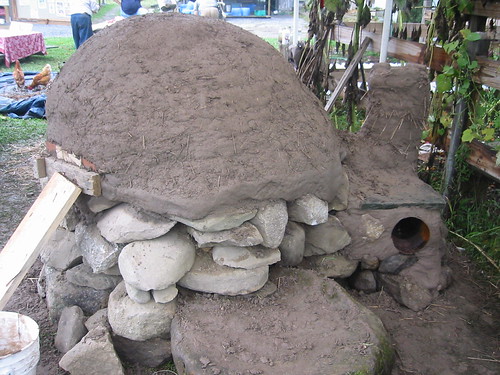
Now comes the earth building chapter! I've been interested in cob for a while (a building material made of clay, sand, and straw or wood chips). I'm inspired by wonderful adobe buildings in the desert, kept cool by their foot thick earthen walls. I dream of living on radiant heated earthen floors, but understand the importance of starting a little smaller.

I was thrilled this weekend to participate in building a cob oven and rocket stove for Phillies Bridge Farm Project in Gardiner, New York. It was a wet weekend, so although we got the oven and stove built in two days, we'll have to wait for drier weather to cut the oven door, remove the sand, and fire up. You can see the all the steps from base to plaster here. You can learn about cob ovens here and rocket stoves here.

The short and sweet is that the rocket stove is the super efficient element, while the earth oven heats slowly then stays hot for a very long time, baking incomparable foods and bringing people together to enjoy breads, pizzas, etc. They are both a pleasure to use. And, I must say, a pleasurable project to spend the weekend on. How often do adults get to play in mud for two days straight?

Jul 22, 2008

pedestrian

Yesterday, in Newburgh, NY, I saw a man get stopped by the police for walking down the street. Sirens, lights, the works. He was walking on the shoulder of a road at an intersection where 5 years ago there was farmland, and now there are strip malls: "essential" things like B&Ns, Lowe's, Mobil stations, Chili's. It was illegal for him to be walking down this road because there is no sidewalk (like most roads these days), and, I'm guessing here, because it is considered a highway by the town of Newburgh. On an already hot and sweaty afternoon, in a landscape covered with black asphalt, this man wasn't allowed to walk home from work. (The Talking Heads song Nothing But Flowers comes to mind here.)

I was flabbergasted, and feel that, for me, this felt like the beginning of the end. I saw all this happen from a car, no surprise, but was so horrified, it makes me want to want to walk and ride my bike exclusively. I'm so repulsed by a culture that makes it illegal to walk in this place that has so recently been taken away from people, and handed to corporations. Sickened by this class crap, that tries to require people to have cars by not funding public transportation.

I'm inspired to give my friend John Francis, of the organization Planetwalk and the book Planetwalker, another read. John didn't ride in cars for twenty-two years to protest oil industry abuses, and has many an interesting story to tell from his journeys. And, bonus, he's another banjo player!

Jun 18, 2008

cooking without oil

Reading an article about solar cookers, recently, I caught myself being skeptical. Waiting 3 hours for food to cook? Would a well-angled box covered in tinfoil really get hot enough? I was sipping my tea and thinking "no way." My sun tea. Newsflash, self! Tea brewed in a jar in the sun is solar cooking.

Pause, challenge own assumptions, consider giving it a try.

If sunshine is strong enough to bring health, burn your skin, power your home, turn whole fields of sunflower faces toward itself, of course it can cook food. Forget police barriers, sometimes I have to get over my own.

*Picture courtesy of the fabulous You Grow Girl.

**Hearsay Warning: I grew up in the desert and always heard a story about a woman who was drunk from an all-nighter, and passed out by her pool. She was so dehydrated and her alcohol level so high that she essentially boiled, and died. Now, it may be a dusty urban myth, but you have to admit it's an awesome story, and a fine example of the power of the sun.

Jun 7, 2008

moving out

When working on my big, old, needy house and worrying about money, energy consumption, and the like, moving into the garage sounds better and better. I'm a longtime fan of tiny houses, and think I'd be perfectly happy living in someone's pool house with a composting toilet and a garden hose solar shower. Other people have taken it further. Read all about it at Shedworking.